



In Overton Park, an old sign still points the way to the Memphis College of Art. Rather, it points to what’s left of it. The school closed in 2020, leaving behind a Midcentury Modern landmark building, also known as Rust Hall, to an uncertain future.
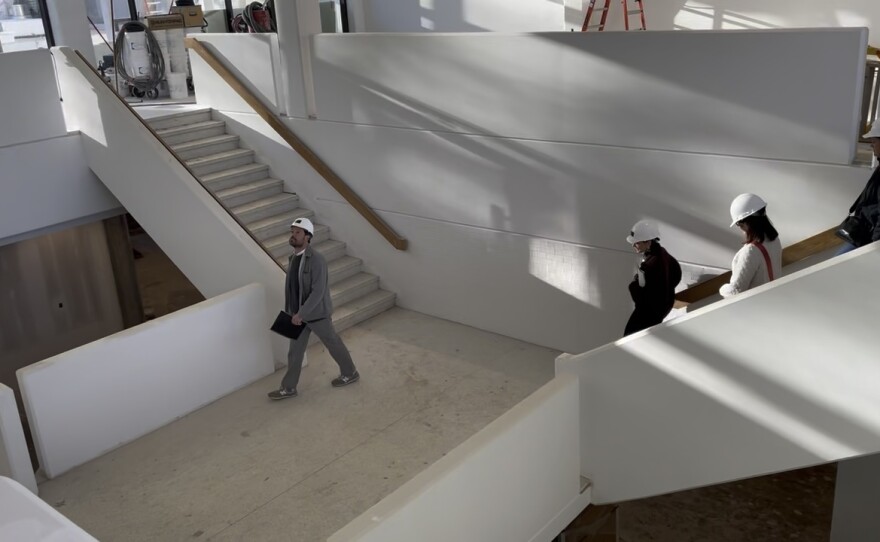
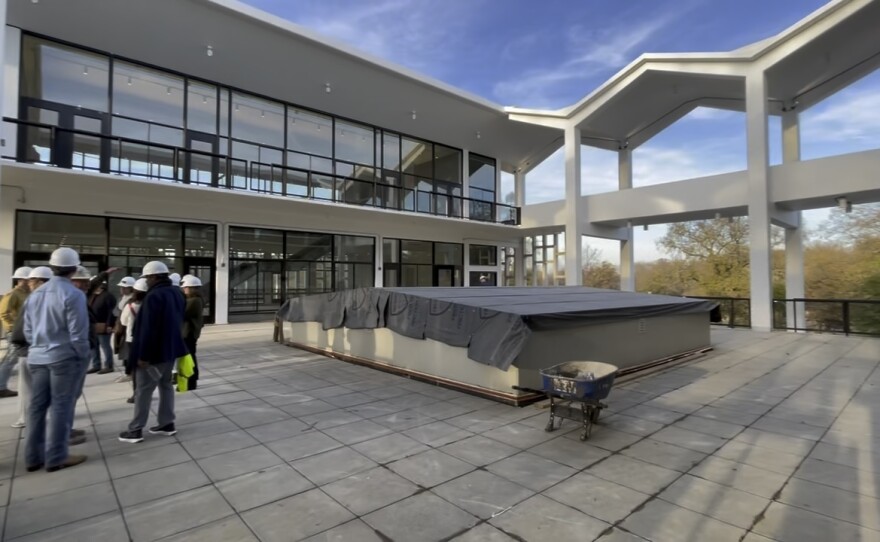
But today, the old campus is in the middle of a major transformation. Earthmovers are reshaping the landscape. The interior echoes with sounds of power tools. This onetime jewelbox of arts education will, in nine months, start its new mission as the home of the Metal Museum.
On a recent tour of the building, Director of Development and Communication Madison Miller started in the central atrium which, for decades, was the college's main gallery space. Here, countless art careers were born.
"The beautiful skylight is under renovation," she said. "So, just to think about all that gorgeous natural light coming in, even moreso than now."
With windows unblocked of walling once used to display student art, natural light will soon flood the interior. Brian Butterfield, design director for WHY Architects, says the project preserves the bones of the building while fitting it for its new purpose.
"So now that it's going to be a museum," he said, "[we're] really thinking about how this works as a public-facing institution, and connecting all these spaces."
For the Metal Museum, the new facility creates a host of possibilities. Miller begins leading the way to a second lobby, the future galleries, education wing and the metal studios.
Founded in 1979 as the National Ornamental Metal Museum, the nonprofit has long occupied a more modest campus just south of Downtown near the I-55 bridge.
Its mission is simple: to “preserve, promote, and advance the art and craft of fine metalwork.” But when MCA shut down, museum Executive Director Carissa Hussong saw an opportunity to raise its profile.
In terms of space, it will go from about 17,000 square feet to 75,000 square feet. Attendance, she hopes, will more than triple from the current 20,000 annually.
She says it wasn’t just about having more room for exhibits, but expanding the mission as a teaching institution.
"It is those educational opportunities, and the opportunities that we've never really been able to explore because we've been so limited by our space," Hussong said. "We can offer what our space allows us to offer."
Blacksmithing, jewelry making, welding… like the old art college, the museum intends to make classes and workshops related to the metal arts open to the public. Hussong also says the museum is looking to partner with local educational institutions.
One of the biggest changes to the former campus is located on the west side of the building -- a working metal studio.
Imagine a kind of hangar, but where large metal sculptures — the kind that get commissioned for gardens and public spaces — can be assembled.
The public, Miller says, can look in on works-in-progress through large windows, "giving that behind-the-scenes view, not only into metalsmithing and the museum, but also thinking about process."
The cost of this new growth is around $32 million, of which $29 million has already been raised. The new museum in Overton Park arrives as another institution, the Brooks, is leaving for its new Downtown location.
Soon, the Metal Museum will be Overton Park’s main art anchor, joining the Zoo, and the Overton Shell as its major attractions.
Landscape Architect Kira Appelhans said a trail of sculptures surrounding the museum will help tie the museum to the park.
"So we feel like it's a point at which the community and the museum will really start to mesh and start to build up that larger institutional support from the people who are just walking through the park," Appelhans said.
For the Metal Museum, the next step is turning park-goers, curiosity seekers, and of course, old alumni of the Memphis College of Art into a new community of supporters.

